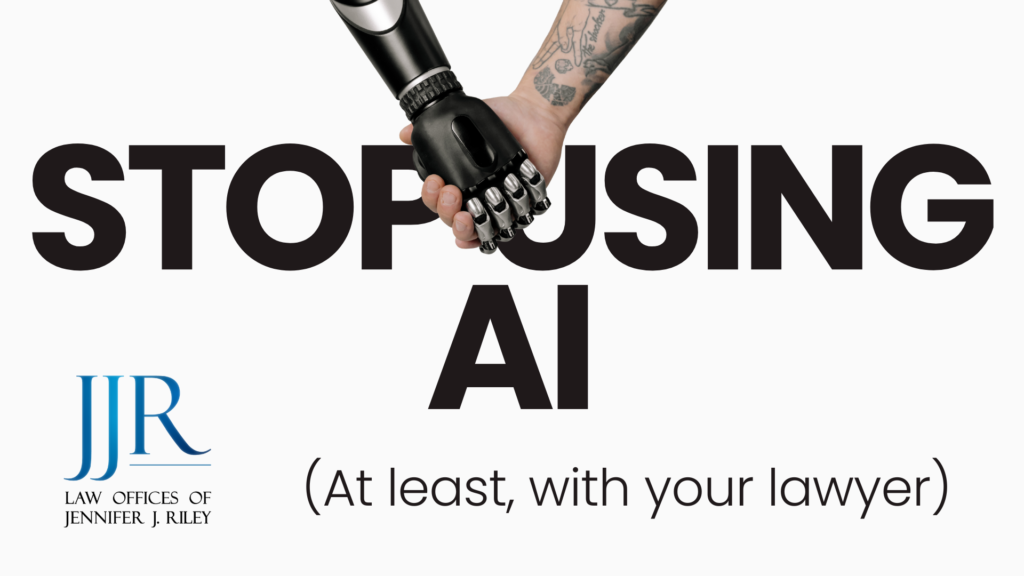
(At least with your lawyer.)
AI is very useful but…
The allure of AI is undeniable. I present to lawyers—locally and nationally—about the expanding role AI will play in the legal profession.
But when something feels “too good to be true,” it usually is.
And while we’re still in the early days of the AI boom, we already know many of the pitfalls. Here’s one you may not be considering:
Using AI in your communications with your lawyer may be costing you more money than you think.
The pattern we’re seeing
More and more, clients are communicating with us through AI.
We can usually tell right away: the traditional font, the bolded subject headers, the tidy bullet points—and the tone. And in these emails (the length of which tends to be unmanageable), clients use AI to “explain” the law to us.
The problem is: these AI platforms always (and we do mean, always) steer clients in the wrong direction.
Most of the time, the “law” cited is just plain wrong.
For example, I asked ChatGPT to list the custody factors in Pennsylvania. It missed them.
Not most of them—all of them.
It created new custody factors, ignored the real factors, and tried to tell me I was wrong.
Why AI gets it wrong (even when it sounds right)
AI tools (including ChatGPT, Claude, Copilot, and many others) do not know the law.
That’s a dangerous combination in a legal case where every move has a consequence.
The hidden cost: you pay for the cleanup
Attorneys spend three years in law school learning the law—but, more importantly, learning how to analyze it, synthesize it, and use their education and skills to represent you. They spend the rest of their careers sharpening those skills, building relationships, and learning how to navigate the legal system.
There is so much more to the practice of law than just the words in the Rules. The practice of law involves understanding the courts and our clients—and knowing how to strategize and plan to our clients’ advantage.
The documents AI drafts are nearly always wrong: they cite imaginary or incorrect rules, and they summarize the law incorrectly.
When this happens, we must spend hours:
AI isn’t saving you time. It’s creating more work—and more costs—for you.
A better way to use AI (without letting it misdirect you)
We understand why clients turn to AI.
Legal jargon is confusing. The process can feel mysterious and frustrating. Continuing to find ways to conserve costs and better understand the legal process is commendable.
However, relying on AI as “truth”—or using it to guide your attorney’s strategy—is not advisable.
The costs are high:
If you’re using AI, tell your lawyer
Be open with your lawyer about your use of AI.
We already know you’re using it.
Help us understand what you’ve read and what concerns you—so we can better help you.
Talk to us so we can enhance how we represent you, using our experience, our education, and the relationships we have built with other lawyers, the court—and with you.